
Why Aren't We Happy? Unfortunately, There's An Answer - Undividing #65
Our brains are useless at predicting what makes us happy. So a woman started a course at Yale to teach us how.
Welcome to Undividing where we are reconnecting a divided world
Hey there Everyone,
Way back in 2017, I was six weeks into my divorce and a total mess. It was all I talked about in my therapist’s office at that time. And a lot of it was about what it was going to cost me, getting taken to the cleaners, the betrayal by someone I supported for 5 years.
But even before that, our sessions were often about all the things I believed I needed to fix, acquire, or get back before I’d be allowed to be happy again.
On this day, he let me get through my list. Then he said something almost as an aside; that in his whole career, the happiest people he’d consistently seen walk through his door were in love, and didn’t have a lot of money.
Ironic, considering he was slap bang in the middle of Hollywood.
And also ironic because it was the opposite of everything I believed in that exact moment; I was sitting in a house I was about to lose half of, running mental spreadsheets about settlements and severance and whether I could even still afford to see my therapist… and have him tell me that the two things I couldn’t reconcile were the two things that mattered the most.
Intellectually I 100% believed him, but spiritually I didn’t get there until this year. Ten years later. Which brings up the question, why does something that’s so obviously true, take so long to believe?
If you know someone who’d like to get in on this conversation, you can share it with them here:
Now, let’s get Undividing…
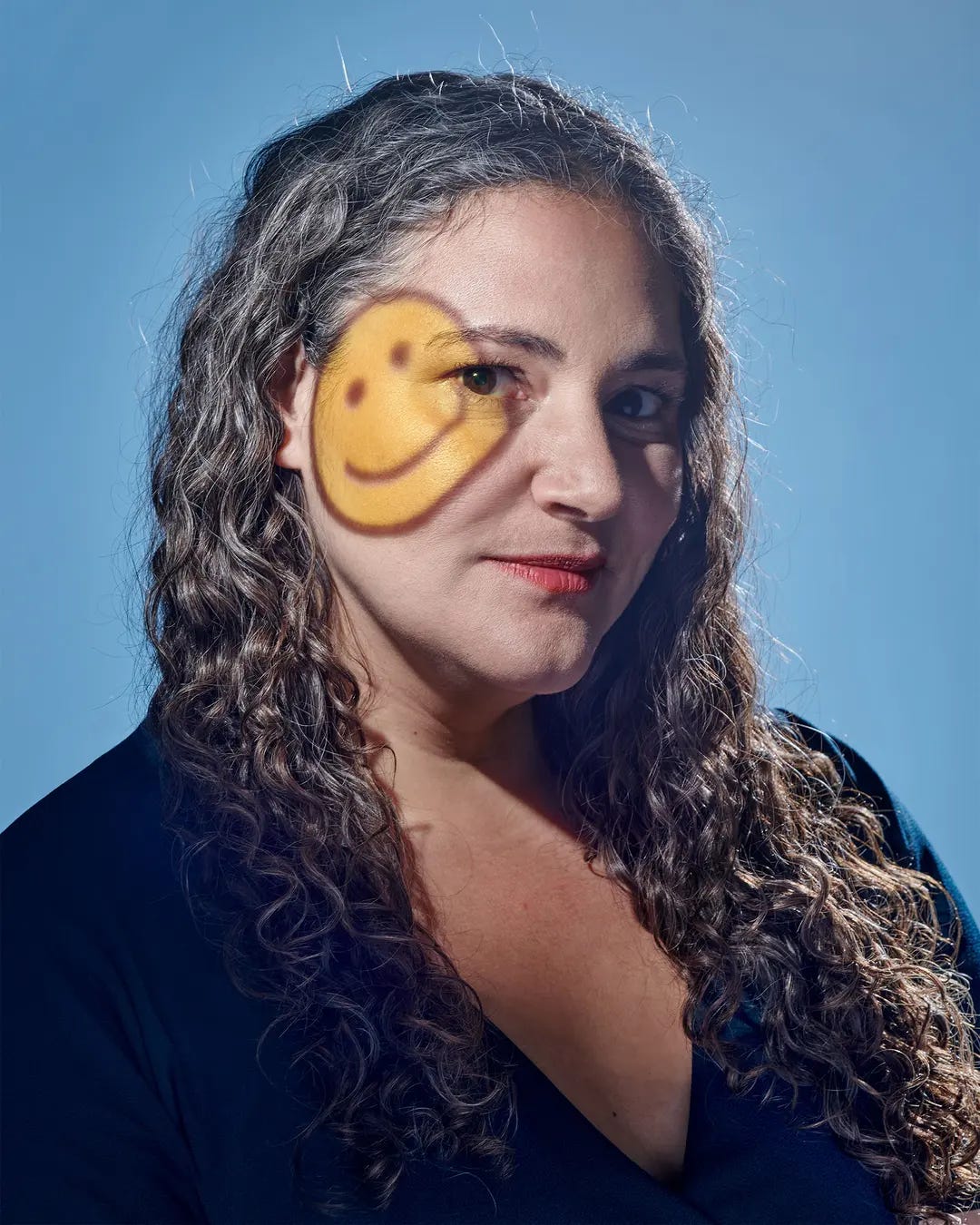
Her name is Laurie Santos
Around the same time that my life was imploding, Laurie Santos was in the throws of getting her course approved for the following year.
In January 2018, a Yale psychology professor named Santos launched a course called Psychology and the Good Life. Within weeks it became the most popular class Yale had taught in its three hundred years. Almost a quarter of the entire undergraduate student body signed up.
The online version, The Science of Well-Being, has since been taken by more than four million people worldwide.
Not because it told students what they wanted to hear. Because, it told them what they’d spent their whole lives getting wrong. Like me.
Santos’s question was this: if we humans are so smart, why do we continually chase things we think will make us happy, that never do in the long run?
Why the brain keeps choosing wrong
What her research uncovered was this: the things humans believe will make them happy have almost no lasting effect on how they feel day to day.
More money. The right relationship. The bigger house. The promotion. All the usual things that we think we’re supposed to chase.
Decades of research are unambiguous on this. Not because these things are bad. But, because the brain was never built to extract lasting happiness from external circumstances.
It even has a name: hedonic adaptation.
In 1978, psychologist Philip Brickman published his study. He started by comparing recent lottery winners to people who’d survived spinal cord injuries and become paraplegic. Within about a year, the lottery winners weren’t any happier than non-winners and, even worse, took less pleasure from small, ordinary things than everyone else did. The accident victims, meanwhile, were not nearly as unhappy as anyone predicted. Both groups had mostly returned to whatever baseline they’d started at, before these events had taken place in their lives.
Santos calls this the satisfaction treadmill. And when I read this, I recognised myself straight away; you work harder to get the thing you believe will make you happy. You get it. You feel better, briefly. The brain adapts. And you return to baseline.
Now you need the next thing. The treadmill never slows down. It only speeds up. And the happiness you were running toward stays exactly the same distance ahead of you the entire time.
Welcome to “Miswanting”
In 2000, psychologists Daniel Gilbert and Timothy Wilson coined a term for the specific way we get this wrong: miswanting. It isn’t that we fail to get what we want. It’s that we’re bad at predicting what life will feel like once we have it.
The brain runs a prediction engine that tells us more money, the next relationship, the next milestone will produce a certain feeling. And these predictions are always, always wrong. Consistently, measurably, across every culture and generation studied. And the brain keeps making the same wrong predictions because it’s never been updated with the evidence that it was wrong the last ten times.

I was guilty of this in a specific and very, expensive way. It isn’t that I wanted things that were bad for me. Actually, that’s debatable. But what isn’t up for grabs is that I had completely mis-anticipated what those things would actually do once I got them.
The dark math I didn’t know I was doing
For most of my adult life, I ran a version of this equation in every relationship: if I am indispensable to a partner, ie if I pay for enough, provide enough, make myself useful enough, the feeling of not being enough will finally go away.
It never did. Whatever I provided, the baseline reset. There was always a next thing to secure, a next way to prove my worth through what I could give rather than who I was. I was doing exactly what Santos describes: chasing external things to solve an internal problem these goals were never built to solve.
And I would say that my ex-partners were all running their version of this. Whatever I provided didn’t make them happy in the long run.
So when my therapist said the happiest people he’d seen were in love and broke, what he was actually describing was two things working against my exact equation.
I wasn’t ready to hear that at six weeks. I don’t think most people are.
Let’s talk about privilege. And buckets.
This week’s Undividing is prompted by a post that’s been doing the rounds on IG that honestly was where I first heard about Santos’ work. And one of the top comments critiquing her theory deserves a proper moment.
I’m paraphrasing but it was basically: this is a privileged take. You need enough money for security first (housing, healthcare, food, physical safety) and only after that does wellbeing science even apply.
That critique is 100% correct.
For years, the reference point for the money/happiness relationship was a 2010 study, which found emotional wellbeing rose with income up to about $75,000 a year and then flattened.
In 2021, Matthew Killingsworth challenged that with better real-time data, finding happiness kept climbing well past that point for most people.
So they had a research face-off in 2023; the two parties ran an adversarial collaboration to resolve the conflict, and the actual answer turned out to be more interesting than either of their original claims. And a bucket analogy of my own I think explains their findings.
Money is like water in a bucket.
If your bucket’s empty, water fixes that fast. Every bit helps. That’s most people in their early income years.
Once the bucket’s full, more water just spills over the side. It doesn’t make the bucket more full. It just runs down your arm.
The surprise they found was that for most people, happiness keeps rising with income, no plateau in sight.
But, and this is the big but, people already struggling financially do level off, around six figures, because their bucket’s still legitimately empty and every dollar is still doing real work.
My bucket was full once the divorce settled and I had a stable income again. But I kept pouring anyway, because my bucket was full and I was trying to fill a different one: feeling loved. Money can’t do that job.
That’s what my therapist meant. I had the wrong bucket.
So, what actually works?
Santos’s course spends most of its time on this question, and the answer is almost annoyingly modest. But one that rings true. And what I find interesting about it, is how much of the last ten years I spent pushing against it.
The things that produce lasting improvement in wellbeing are the things many of us deprioritise. Things like strong social connections, deliberate acts of kindness, fully experiencing ordinary positive moments, sleep (so guilty here), movement, and specific gratitude.
The good news is that three practices, according to the research, do most of the work.
1. Savouring. It’s the deliberate practice of staying inside a good moment long enough for the brain to actually register that it happened. Not photographing it. Not posting it. Not half-experiencing it while already thinking about the next thing.
In that post, the researcher they referenced said 12 seconds is the minimum. 30 is even better.
2. Gratitude. A specific person, a specific thing they did, a specific effect it had on you, said or written directly to them. I like a good gratitude list. But saying it to the person is apparently even more effective. Martin Seligman’s original 2005 study on this found the gratitude letter produced the single largest, fastest jump in wellbeing of any intervention his team tested.
3. Concrete replanning. Yes, replanning. Actually redirecting the time currently spent pursuing things that don’t work, towards the things that do. As investment in your future happiness. One hour less on the phone. One hour more with someone you love. One purchase less, one experience more.
It’s a self-administered software update, running on evidence instead of instinct.

To wrap up…
Ten years after I nodded my head in my therapists office I was still convinced the fix was somewhere out there to be acquired.
It took years of letting things go, writing my book, arriving at the conclusion I was enough, running tests on that with friends and lovers, then really, truly, realising I was enough.
Then I met Erik. And then I also realised that I had stopped needing a partner to solve the problem money never could. We don’t have a lot of money. And we’re in love. And it’s profound in a way I couldn’t grasp ten years ago.
Our brains were built to chase status, resources, and certainty because those things kept our ancestors alive. But the update is available. The strange part is that all it asks us to do is what we already know works.
Pick one thing from the research above. Just one. This week, save fifteen minutes to fully stay inside a good moment without reaching for your phone. Or write the specific gratitude letter to the specific person, even if you never send it. Or take one hour you’d normally spend on the thing that doesn’t work, and give it to a person you love instead.
The most important part is just to begin. And I hope that it takes you a lot less than the decade it took me.
Actually make that five and a bit decades.
Karl
But what does your own research tell you? Who is the happiest person you personally know, and what does their life actually look like? Let me know in the comments, I’d love to compare notes.
Sources:
Miswanting: Some Problems in the Forecasting of Future Affective States — Gilbert & Wilson
Lottery Winners and Accident Victims: Is Happiness Relative? — Brickman et al., 1978
Kahneman and Deaton Resolve the Income-Happiness Debate — Princeton
How can you support Undividing?
Like, comment and restack! It all helps the algo push Undividing into people’s feeds.
Have you learned anything in Undividing that’s helped you in your life? Given you a new perspective? Helped you feel connected to the good in all of us? If so, consider taking out a paid subscription.
You can also Buy Me A Coffee. I post you back a personal 60 sec video for any donation, any size. (Ignore the BMAC amount prompts, you can enter any amount)
You can also support by picking up a copy of my award-winning book How To Burn A Rainbow, the story of how my divorce set me off on a journey - a riches to rags rollercoaster from LA to Berlin where I had to lose it all to find myself.
Happiness is - something to do, something to look forward to and someone to love. Livingstone
One of my favorite quotes attributed to Abraham Lincoln is, "Most people are about as happy as they choose to be."
I take that to mean happiness is a choice. I try to walk that out in my life by appreciating the little pleasures the most. The smell of rain, a beautiful sunset, my adorable and devoted dogs, acts of service and kindness. It would be nice to be in love and be loved romantically but even if that isn't in the cards for me I can be love and for that I am grateful.